

Used by venture studios and cohort programs running real team decisions


The team is the #1 startup killer, and the last gut-check decision in venture.
You diligence the market, the product, and the financials. The decision that actually kills companies runs on a read you can't show anyone.
What you noticed evaporates
Turning a gut call into something defensible to partners takes 3 to 4 partner-days. Then it lives in nobody's system, and the next decision starts cold.
Assessments profile employees
Hogan, PI, and DISC describe teams that already exist inside stable companies. Static reports, consultant scheduling, never checked against outcomes.
Trials burn runway first
EIRs and six-week programs surface real behavior only after months of salaries, an estimated $60K to $120K of runway. And they can't run before capital commits.
Each covers a fragment, and every one of them examines people one at a time. Teams don't fail one person at a time. They fail in the combination.
You've been betting on teams for years. We give you the data to back it.
Tellstone runs the decision you're already making. Capture what you notice about everyone you meet, simulate any scenario against the actual goal, and keep score on whether you got it right. You stay the judge of talent. We just make sure you're never judging blind.
Capture your bench
Add anyone from their LinkedIn profile in one click, and write your observations without leaving the page. Slack and Google Calendar ask you after you meet someone new. Your bench builds while you work, not in a session you have to schedule.
Simulate the scenario
Drag any team permutation against the actual goal. Raising a round and shipping a product stress the same people differently. Get the archetype, the superpower, and the primary risk, with the evidence behind each.
Track the outcome
Log whether flagged risks materialized. Every outcome calibrates the next call to your portfolio, not a generic dataset. Nobody else keeps score.
Your bench builds where you already work
You are in LinkedIn every day. You are not in Tellstone every day. So Tellstone comes to you.
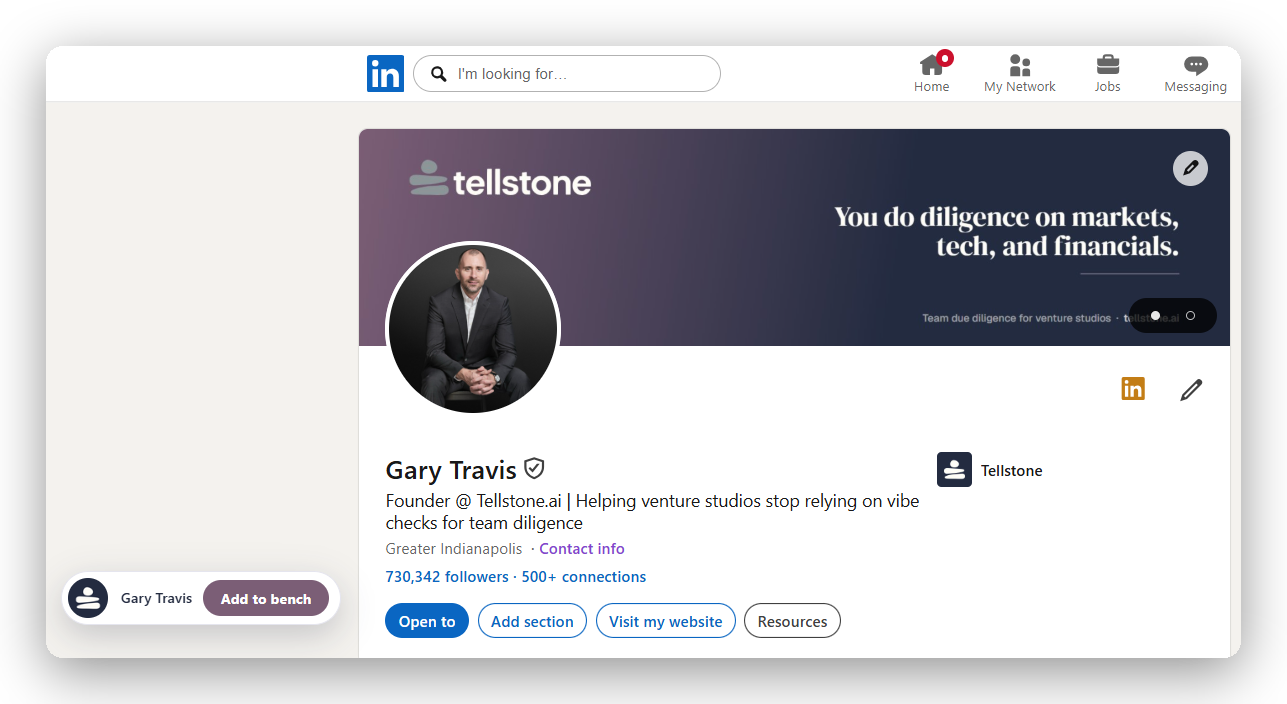
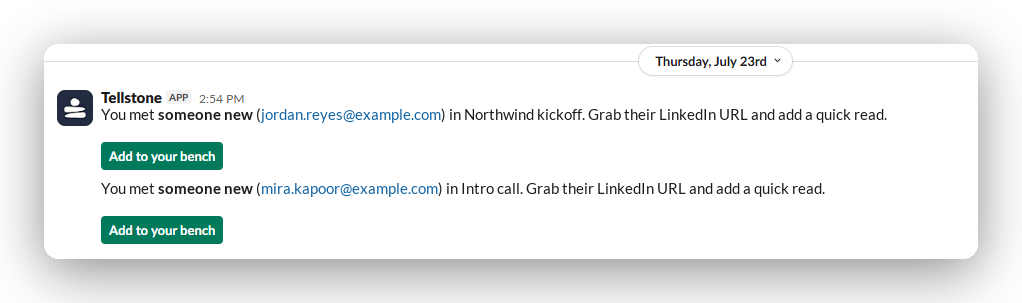
One click, no new tab
An Add to bench button sits on every profile. One click adds them, and your observations open right there on the page.
It asks you first
After a meeting, Tellstone asks whether you met someone new. Answer in Slack without opening a browser.
Nothing to remember
Meet someone new and Tellstone notices. It sends you the profile and a link straight to the form.
All three ask the same three things. How well you know them, how they work, and anything worth remembering.
Built to do the four things the workarounds can't.
It reads the combination, not the résumé.
Every tool in your current stack scores people one at a time. Tellstone's unit of analysis is this scenario against this specific goal, which is where teams actually break.
It lands inside the decision window.
Trials and consultants deliver the truth after the money moves. Tellstone delivers it in minutes, while the risk is still cheap to act on.
It turns unease into a testable risk.
A vibe can't be mitigated. A named risk with evidence, mitigation plays, and interview questions can be tested in the next meeting.
It keeps score.
Nothing else in the stack logs the call and checks it against what happened. Tellstone does, so every decision improves the next one.
One question decides everything
What team decision are you making in the next 60 days?
Built for venture studios, accelerators picking cohorts, and early-stage investors with real post-investment leverage.
Run the team decision you're facing right now. Pick the example that fits.
No decision on the table right now. Start your bench so the next one doesn't begin cold.
Start freeThe painkiller. Bring us the decision you're making this month.
- Drag any scenario and run it against a real goal in seconds
- The single biggest risk, the evidence, and three mitigation plays
- A partner-ready memo in minutes, not the 3 to 4 days it takes now
The daily habit. The next decision never starts cold.
- Add anyone from a LinkedIn profile in 2 minutes with your observations attached
- Send the full 30-minute assessment when the stakes rise, Big Five plus 10 startup soft skills
- See the spread between your observations and the assessment, where you were right and where you were blind
The multiplier. Your portcos make team calls every month.
- Your portfolio companies make team calls every month, under one studio license
- Every prediction scored against what actually happened
- A model that calibrates to your portfolio, not a generic dataset
We keep score. Here's the score so far.
Every flagged risk is logged and checked against what actually happened.
completed assessments in the production dataset
A biostatistics professor at the IU School of Medicine took the assessment and confirmed it holds up against personality science.
The best proof is the one you generate yourself. Run it on a team you already know, starting with your own partnership.
Start free. Upgrade when a decision goes live.
Purdue Innovates and Paragraph Ventures already use Tellstone.
- Unlimited bench. Add anyone from LinkedIn, Slack or your calendar, with your observations attached
- Filter by personality, soft skills, background, level and location
- Every partner records their own observations, and you see where you disagree
- Send the full assessment to anyone you add
- 1 scenario and 2 simulations, with the full report to share and print
- 10 sandbox runs to practice on
No credit card, no sales call.
Run your next live team decision with us. Everything unlocked for 90 days.
- Everything in Launch Partner, unlocked for 90 days
- Kickoff: we build your bench and run the analysis with you, live
- Follow-up: after you've talked to the team, we log what happened and you decide whether to continue
- Your talent pool, your observations and every report are yours to keep
One per organization. Credited towards the annual plan if you continue within the 90 days.
- Unlimited scenarios and simulations
- Unlimited portfolio companies
- A profile of the person each team is missing
- A direct line to the founder, feedback ships in days
- Our predictions get more accurate as we learn your studio
Buy this year and this rate is yours at renewal.
The science behind Tellstone
Every empirical claim is cited to peer-reviewed research, and we're equally explicit about what the method can't do.
The Composite
Why combining partially-independent signals beats any single one, the principle behind 85+ years of selection research.
The Assessment
Why we use forced-choice paired-trait questions, how they resist faking, and how the soft skills are scored against published rubrics.
Honest Limits
What self-report can and can't do, who Tellstone is for, and what it is explicitly not.
Frequently asked questions
-
What is Tellstone, exactly?
Tellstone is team diligence. You assess founders, build team scenarios, run simulations, match talent, and track how those teams actually turn out. Everything you record stays in one place and builds into your studio's own record across the portfolio. It's a workspace you use for every founder pairing and early team decision.
-
How is this different from DISC, Gallup, Predictive Index, or generic founder assessments?
Those tools look at employees and teams inside established companies, one profile at a time, on a consultant's schedule. Tellstone is built for the moment a company is being formed. It pairs founders who have never worked together, builds a scenario against a real goal on a deadline, and tests where that team is likely to break before money goes in.
-
What does it cost?
Most organizations start with a First Team Decision at $1,500. That is two working sessions on a live decision, with everything unlocked for 90 days. It comes off the annual if you continue within those 90 days. The annual is $4,950 per year for unlimited scenarios, simulations and portfolio companies.
-
Is the $1,500 for one team?
No. It is the full product for 90 days, unlimited. We run your first live decision with you across two sessions so you can run the rest yourself.
-
What happens after 90 days?
Continue and the $1,500 comes off the year, so you pay $3,450. If you do not continue, you keep your bench, your observations and every report at free limits.
-
Is there a limit on portfolio companies?
No. Add as many as you need.
-
How accurate is it?
Tellstone matches what it sees against documented failure patterns. It is not a prediction of the future. Every flag shows the data behind it and the pattern it matched, so you can judge it for yourself. Calls get tracked against what actually happens. In early customer follow-ups, 8 of 9 primary risk calls were confirmed real by the teams themselves. The best test is your own. Run it on a team you already know and see if the read holds up.
-
What kind of time commitment is required from founders?
None, unless you invite them. Describe what you've observed about someone, add their LinkedIn, and Tellstone builds an observed profile you can simulate the same day, with no time from them at all. It stays labeled as observed until they take the assessment. If you do invite someone, the assessment takes about thirty minutes, once. It saves as they go, so they can stop and come back, or finish it over a few sittings. No prep, no scheduling. Tellstone pulls in work history and public context automatically and handles the analysis from there.
-
We have a live team decision this week. How fast can we get a read?
Same day. Describe each person involved, add their LinkedIn, and run the simulation today. Those profiles stay labeled as observed until the assessments come in. You can send the assessment to the people who matter most, and the picture gets stronger as they finish.
-
Is founder data confidential?
Yes. Your workspace is company-scoped and no other studio can see your data. When you confirm an outcome, we keep a de-identified record of it to improve the model, with names and emails removed. Founders can request data deletion through their studio at any time.
-
What do studios actually get back?
A workspace that stays with you, holding assessed founder profiles, tools to build a team, talent matching against the role you're missing, simulations with the risks written out, a side by side comparison of two scenarios, outcome tracking, and a view of risk across the whole portfolio. Any analysis can be exported as a PDF or a PowerPoint.
-
When is the best time to use Tellstone?
Use it when a team decision is 60 days out. Picking founders, pairing co-founders, choosing a cohort, a key hire, or friction between partners all count. That is Live Decision Mode. If nothing is live right now, start with Bench Mode and add the people you meet as you meet them, so the next decision doesn't start from scratch.
-
We only put a couple of teams together a year. Is this worth it?
The founding team is the biggest call, but it's not the only one. You pick founders and then work beside them, so founder and partner fit comes up constantly. Your portfolio companies hire key people all year, and those hires are the next biggest call after the founding team. Between deals, your bench lives here, with your observations attached to every person you've met.
-
How do we get started?
Sign up free and run your first simulation the same day. Create your workspace, add people by describing what you've observed or sending the 30-minute assessment, and build a scenario. Want to see it working first? Open the sample analysis, then try it on a team you're actually deciding on.